Monday, October 31, 2005

A qxqqllfb Word

If I might, could I have a qxqqllfb word with the person who chose type faces for the vwvllfyg blogspot word verification that I have to type every time I comment? I think that he or she should learn some things about visual discrimination.

Ms. or Mr. Verifier needs to know that ps and qs and ds and bs are the hardest letters for HUMANS to sort out. I thought the object was to screen machines.

Unless of course, the gyhccpqpq irritation is intended. Then I know this pqpbdffld system was designed by my eighth-grade teacher—he used trick questions to exact revenge.

Even then I don’t jgjlfrlyzsz understand one thing. If I’m signed in and on my own blog, why do I need to verify?

Will blogspot turn it off for me on my blog, if I promise not to spam myself?

Fine. If the evil typeface person won't see me. Would you leave this yuqbmnffyu comment please?


Watch your ps and qs and what the heck is this?

—me strauss Letting me be

The Only One

No matter how it looks to everyone

no one really wants to be

the only one of anything.

—me strauss Letting me be

NFTV: A Young Man of Letters

You might recall the pilot of Nerd Family TV, The Milk Story. Our son was half past age three. He was obsessed with spelling everything that he saw. This episode happened that same season.

My son had connected with letters. They were friends. They shared secrets. My son knew things—which were boys, which were girls, and who liked to show off. He could spell by their place in the alphabet—12-9-26 that was me. They were an extension of him.

When most kids were playing, this beautiful boy with the icy-blonde hair would be at his table, writing the alphabet. He was drawing portraits for a gallery. He wanted to write them just so. He wrote them in order, choosing a color for every letter. He was a young man of letters.

Now and then he would stop to write a word. Guitar. Beautiful. I still have them. Then he’d go back to writing letters. I’d watch in complete fascination, wondering what he must be thinking. Where’d he get all that focus? He didn’t talk much for a boy of his age. So it wasn’t likely he would tell me.

At night when I tucked him in, he might tell me about his alphabet friends—if I’d sit on his bed and ask questions. I could coax a few words out of him. It was worth the trouble. I can still see the light in his eyes outshine the light from the hall. I also remember that sentence.

“Talk about letters.”

Letters and spelling, and spelling and letters. I could name other things we might talk about. When I’d try a rhyme, or a song, or a story, he’d listen. He was humoring me. Soon enough we’d be back again.

“Talk about letters.” I know about one-track minds.

What can I say? He was my son. In the dark in his room, I could get him to talk—as long as I talked about letters. Tucking him in became an interview. I looked forward to it and found it exhausting. I had to ask questions about letters. Sometimes I didn’t want to. If I started to leave, he’d say something intriguing.

This was one of those nights. I’d tried to talk about anything—anything other than letters. I didn’t care about A-Z. I wanted to tell a story. It seemed that was out of the question. The alphabet was out of the question for me. Good-night-kiss time had come. I gave him my best one.

“Sweet dreams.”

“Twinkle, twinkle.” That was my little boy talking. It got my attention. I listened.

“Go on,” I said, feeling a flood of relief.

“Twinkle, twinkle little star. How I wonder what you—T.”

Then he just started laughing. So did I.

Like I said, he was a young man of letters.

This was Nerd Family TV.
—me strauss Letting me be

Sunday, October 30, 2005

Too Cool to Keep Undercover

Some comments deserve the light of day. This comment to "Walking on Water" from wisewoman, Kelley Bell, at The Daily Blog with Kelley Bell is one.

--------------------------

Kelley Bell said...

ahha, syncronicity.

"I wanted to ask everyone, What do you want from me? I can't walk on water.”

LOL

And over on my bloggy, I just posted a thing about atoms. They are not solid. Just energy and empty space.

So what is holding us all in place? What is solid?

If a chair is just atoms, which are just energy and empty space, like water, then why can one hold us while the other can not?

Quantum Physics teaches that energy is not a thing, but rather, just the probability of ideas.

Therefore, Ideas Create Reality.

and if all this is true, then why is it so unthinkable that someone who BELIEVES she can walk on water

actually can.

--------------------------

The logic and joy of the comment made me laugh when I read it. I told Kelley, and she was laughing too. We were laughing together. I had to share it. Some things are too cool to keep "undercover."

—me strauss Letting me be

Scribbles Interview: Chameleon Clive Allen

This Just In from the 65th Crayon:

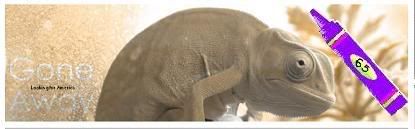
Choosing to stay in the Internet for a while, the 65th Crayon pulled a few colorful yarns and strings and managed to snag an interview with a local hero, a colorful character himself, Chameleon Clive Allen. Though he is best known by that, his human name, many are unaware that Clive is indeed a chameleon. His given name is Gone Away, which is also the name of his popular blog, not long ago featured in the Blog Herald's 100 Blogs in 100 Days.

“I had asked Gone about an interview several weeks ago,” The 65th Crayon said. “But the MIT business came up unexpectedly and put a pencil in our crayon box. We had a little trouble connecting—totally my fault.” The crayon admitted.

“When we were finally able to connect, it turned out to be one of the most enlightening interviews I’ve ever done. That chameleon has been more places and done more things than the Geico Gekko—who doesn’t even seem to be with Geico any more; does he now?” The reporter pointed out. “Gone's answers were so forthcoming and genuinely colorful—not at all bland or neutral as one might expect from a chameleon. I think we should run this interview as a Q&A. Let's let everyone get to meet the real chameleon.” The young journalist argued and we agreed.

As part of the colorful bonding thing, the 65th Crayon preferred to address Mr. Allen by his chameleon name Gone Away.

Gone, what was it like growing up as an English chameleon in Africa?

Hot, basically. I am not very susceptible to variations in temperature but Africa was always either hot or hotter. In time it becomes a bore and one wished for snow and ice and wind and storms. Apart from that, it was a life ideally suited to a young chameleon, with wide open spaces to explore, freedom to do pretty much as I wished (both my parent chameleons were working and I was allowed to run free) and very little to care or worry about. The education too was better than I might have received in England, the schools being way behind the times and [so they were] still involved in disciplining and educating their students.

All in all it was a privileged lifestyle and the best way for a young chameleon to grow up. I am always grateful that chance, in the form of my chameleon father, brought me there and allowed me to become the chameleon I am today.

Did you have any close relationships with crayons? Overall were your relationships with crayons positive or negative? How are crayons seen in Africa?

Crayons are as common in Africa as anywhere else and, as a very young chameleon, I knew quite a few. In my late teens, however, I discovered the world of oil paints and, from that moment, crayons never figured largely in my life. This was not from any dislike of crayons, you understand, but more that I was fascinated by the possibilities that oils seemed to hold out. For many years I hung out with them but, in the end, I realized that there was a wider world out there that called to all chameleons. I left and have never looked back.

If you are thinking of ever visiting Africa, my 65th friend, I must warn you that it is best for a crayon to stay out of the sun as much as possible. It can get surprisingly hot and, as I’m sure you know, heat can have disastrous effects upon a crayon’s shape and ability to stand up.

Being a chameleon journalist must present many challenges. Can you share some of them?

I have always found the greatest handicap in a chameleon journalist’s life to be the matter of operating a keyboard. Our small size dictates that we cannot stretch from one end of the keyboard to the other and pressing the keys is somewhat of an effort. Over many years, I have learned to use all four of my feet, my tail and my (rather beautiful and extremely dexterous) tongue to hit the keys and I can now type almost as fast as any human. It is a bit exhausting, however.

Otherwise, it has been an advantage to be a chameleon. My ability to disappear into the background has meant that I have been unobserved in many dangerous situations and my swiveling eyes have enabled me to miss nothing. This is the reason why I am often the only reporter to have gained access to certain stories—a definite advantage, I think.


Tell us, Gone. What brought you to America? Where are you exactly? How did you happen to choose that location? Who came with you and how are you financing your stay? How long will you be with us? (Sorry I know that’s a lot of questions.)

What brought me to America? A Boeing 777, I think it was. But seriously, it happened because I was married to an American chameleon (I must mention here that American chameleons are not true chameleons—they look much the same but lack some of our more amazing abilities—my wife, Kathy, and I do not dwell on such minor matters). After living in England for a few years, my wife became homesick both for the States and her family and it was decided that the only cure was to hop over the ocean and live in America.

We live in Lawton, Oklahoma, a little town in the southwest corner of that state, and this was chosen purely because it happens to be the place where Kathy’s daughter and son-in-law are resident at the moment. The cost of living here is quite reasonable, too; a matter that we had to consider since our finances are not exactly overwhelmingly huge. We have a small income, sufficient to keep us, and the intent is to stay, my dear 65th. Like it or not, America is stuck with me.

Have Americans shown any discrimination or positive attraction to you that you attribute to the fact that you are a chameleon? In other words, does being a chameleon work for or against you in our country?

I’m glad you asked that question. Let me say right at the outset that a chameleon does not enjoy standing out from the crowd or being conspicuous in any way. We are designed to remain hidden in most situations and we prefer it that way. This has not been possible in America, however. The moment I open my mouth to speak, everyone realizes that I am “not from here”. Whilst this is rather uncomfortable for me (and, for a time, drove me to keep my mouth firmly shut), I must admit that it is an advantage rather than a hindrance. You see, they love the accent. Of course, you and I know that chameleons do not have accents but everyone that I meet seems to be in possession of one and so assumes, because I speak differently, that it must be an accent that causes it. I refrain from pointing out that it is they who have the accent and so friendly relations ensue almost without fail.

I have found the Americans to be completely free of prejudice against chameleons (perhaps because they meet so few of them) and they are open, friendly and hospitable to an extent not seen in many other places in the world. Since I only have experience of the Midwest and the South, I should add that things may be different in other parts of the country (I have heard, for instance, that New Yorkers have a reputation for being a little more robust in their manners). But, for the moment, my statement holds true.


How has your blog had an impact on your career as a chameleon journalist? What will you do with the content when you return to your homeland?

Ah, where is home to a chameleon like me? I had thought that home was England (and, in some ways, it is) but now I find that I can be at home anywhere. Perhaps my years in Africa made me more able to be free of concerns of place and location.

But the blog: it is a double-edged sword. It has given me the chance to reach more readers than were available to me before and it forms one arm of my quest to be published in traditional form. But it is also enormously time-consuming and has demanded a concentration upon itself that works to the detriment of approaching agents and publishers. I am hoping that I will be able to get the thing more under control in the near future so that my time may be more evenly distributed between my various activities. Part of the problem is, of course, that I enjoy the blog so much. . . .

As to what happens to the content, who knows? There is a vague thought that, were I to find a decent publisher and the books become reasonably popular, some of the blog could be published in traditional format. But, as the monkey said after he’d done his business behind the curtain, that remains to be seen.


Have you any advice for young chameleons who might want to be journalists?

A chameleon is a slow-moving creature and journalism is all about speed and the moment. Write books, young chameleon, write books!

Anything else you might want to add?

Chameleons don’t do math. Oh dear, I seem to be in weak pun mode. Just buy the book, if it ever gets published, buy the book, my good friend! (Its title is The Gabbler’s Testament and sneak previews may be read by going to Sneak Preview 1 and Sneak Preview 2.

Many people in this part of the Internet are unaware that Mr. Allen is indeed a chameleon and that the picture at the top of his blog is a picture of him. His name, Gone Away, is Chameleonian for no longer in his native land. Legend holds that Gone Away was given this name at his birth by a Chameleon shaman who foresaw it would be our friend’s destiny to make his home in many parts of the world with many chameleons, people, and crayons.
—me strauss Letting me be
-----------------------------------------------------------------------------------------
For links to additional Scribbles Reports by the 65th Crayon see the sidebar listing under his picture and profile.
Scribbles Reports by The 65th Crayon appear Sundays in Letting me be ...
The 65th Crayon is a copyright of ME Strauss. All Rights Reserved.

Saturday, October 29, 2005

Smile that Way

I can remember three distinct times. Three times it happened. Three times in my four college years. Three times, three places, three boyfriends.

I made a phone call to my dad.
Then I went back to where I was.

Three times a boyfriend said,

“One day I hope to be the one who makes you smile that way.”
One boyfriend did.
—me strauss Letting me be

Walking on Water

I thought I needed thinking. Time. A place to spread my mind, room for my soul.

I had read about a trucker who would drive two states away when he had things on his mind. He’d sit at a picnic table by the Mississippi River for as along as he needed to and when he was ready, he’d drive home again. I didn’t have a picnic table by the Mississippi River, but I had my car and plenty of music to take me wherever I needed to go.

It had been a long week.

Some weeks are longer than others. The ones with Monday holidays seem longer for some reason. This five-day week was longer yet. The five days, for all that had to and did get done, seemed to drag and fly at the same time, and yet I didn’t seem to be part of it. I didn’t seem to be a part of anything. I just overachieved my way through it. How long would I do this?

I wanted to ask everyone, “What do you want from me? I can't walk on water.”

I gathered a few things. I put my wallet in my back pocket, grabbed a jacket just in case, and closed the door behind me. I walked down to my little blue car, put the key in the ignition, and drove west. It was morning when I left. I had no place to go, nowhere I had to be. I’d let my car and the roads decide. I didn’t want to pick.

The movement of the wheels on the road was in time with the music. The city falling further away in my rearview mirror, I got lighter by the mile. Maybe it wasn’t thinking that I needed. Maybe I had done too much thinking already. I pulled off to the side. Unclicked the latches to the top and pushed it back. Top down, now I had the sky along with me for the ride.

As the sun moved west with me, my posture softened. The music got more joyful. I started noticing how lovely the trees looked on this last “sort of warm” fall day. Memories of childhood things were floating in my mind like kids whispering.

I stopped for a late lunch at Nick’s diner. Lunch was a chocolate milkshake, an old-fashioned hamburger with ketchup, mustard, pickles, onion, and ordinary—the good kind of ordinary—French fries. They were served by a woman named Doris. We talked about old-time root beer stands and real hot fudge sundaes. She was my entertainment for an hour and thirty-seven minutes. When I was done she pointed me in a new direction. I’ll probably never forget her. Doris was my friend.

About two hours down the road that Doris spoke of, I found it. Boy, it was worth driving for. The sky, the sun, the water were waiting just for me. I eased off the road. I love that sound of tires on mulchy ground. I stopped the car, turned off the ignition, and just stared for a while. I grabbed my leather journal and went to find myself.

An old wooden crate sat there in the perfect spot to watch the sun and write. How it happened to be the only one and just my size, I’m not about to question. I sat down and pulled up the world.

It’s nice to have the world in front of me instead of on my shoulders. It’s hard to see how lovely the planet is when you bear the weight of it.

I wrote that in my journal as I watched the sunset.

I thought of the ways I weigh myself down with heavy thoughts and drama. It’s like covering me with so much oil. I shook off that greasy thought and set aside my journal. Instead I watched the sky change color—glorious tints of blues and grays and lavenders moving back from pinks and oranges and yellows. I felt so much room for me. I wished I could bring people here every time they asked what art meant, . . . or simplicity, . . . or elegance, . . . or peace. Yeah peace. Peace backlit with joy. Now there’s a definition of elegant simplicity.

The sunset sent a beam across the water home to me. That image of a trail of light brought my day’s journey back to mind. I had left home feeling broken, beat-up, and defeated. Now I believed that I could step out on that path of light and walk on water to the sun. The magic of a sunset can cure an aching heart, can still a restless mind.

I stayed until the path of light had faded into the water. Then my dream had run away with the sun to places people do not go.

I gathered up my things. I touched the crate one last time and looked out at the water under the starry sky. Then I closed up the car, got in, and turned the key in the ignition. I forgot to put the music on for the longest time. The amazing memory of the path of light kept playing in my mind.

For one timeless moment, I believed that I could walk on water.

The memory is a kindness that was bestowed on me.
—me strauss Letting me be

Friday, October 28, 2005

Actor's Studio


Welcome to the Actor's Studio

No one ever leaves an interview
without being asked:

What's your favorite word?

—me strauss Letting me be

Clay Hills and Quicksand

Everyone called them the clay hills. They were slag heaps really. Left over from the coal mining that had been before it became a national park. It was one big field of clay hills and valleys. But not to us. My six cousins and I knew better. That dirt in between wasn’t black. It was khaki tan and cracked in wicked, wet squiggly cracks as far as a kid could see. It was the same between every row of clay hills. Only one thing looked like that—quicksand. It was quicksand for sure. Even our parents agreed.

How fast we returned to those hills year after year, cutting out after each picnic lunch to have another quicksand adventure.

Our stage, the clay hills went on for miles, clear to the bluff that you couldn’t see past. That bluff was something. Like the Great Wall of China, it went all the way from the river up north to the road down south. It made sure those clay hills weren't getting away. Scraggly and dry with branches growing out of it, it was the only bit of green in the western view. If you looked to the east you saw forest, to the west you saw only the sky and the bluff. We always wondered what was over that bluff.

That was a fine year when we decided to find out. That year we buried the banana, thinking we’d come back to find it the next year in those look alike hills. How silly we were. What fun it was too.

We found some rope. Where did we find it? We tied it ‘round us waist to waist. I still see us climbing up that first heap, walking along the top of a row, rows and rows on either side of us, walking west into the sun until it got too easy, too boring. Then we invented a reason to brave the quicksand below, to walk between the slag heaps. The ooohing and ahhing and be carefulling were whispered and very dramatic. The quicksand could take us all down, slowly sucked underground together, never again to be heard from. We’d seen it all happen in the free movies downtown on Saturday mornings.

But we were determined to make it to that last bluff. It was as if we were in some old Western movie—when you're a kid a movie's a real thing—and on the far side was the cavalry. So we tread our way one step at a time. Who knows how long it actually took? Each step was tested, tried, and cautiously put, hoping that no one would sink. By the time we were half-way there, problems forced us up on the heaps again. The little kids were getting whiny. They were starting to ruin all our fun.

We made it to the end of the row and down. Slowly we crossed the last bed of quicksand. The climb up that bluff was pioneer teamwork, seven of us roped together. We pulled each other up—one by one—until we reached the top. Finally after all these years, the bluff was not in the distance. It was no longer a giant backdrop. Finally we knew what was on the other side.

More clay hills and quicksand—as far as a kid could see.

The letdown lasted about a second.

We were still atop a kid-sized mountain, and there were clay hills and quicksand filled with danger to keep us busy all the way back.

—me strauss Letting me be

Thursday, October 27, 2005

Curious about Curiosity

My friend Margaret says that I’m the most curious person she knows.

I ask her, “Does that mean I’m really strange or that I ask a lot of questions?”
She answers, “See.”

-------

I credit my curiosity for everything I know.

But people often mistake curiosity for other things.
Things I wouldn’t want to be.


Some people can't conceive of a question asked without judgment or opinion.
They must have no experience with curiosity.
—me strauss Letting me be

Wednesday, October 26, 2005

Scatterlings and Seers

Once there was a little girl with eyes that see deeply. She could see more, more and different things than other people see. She could see at the cellular level. She could see how people were feeling and what they were thinking. She could see their thoughts in just a word; see what they would do by standing near them. Being just a little girl she didn’t know that others couldn’t do this. She knew only that it was a way to help people.

She often helped people.

When she saw someone was hurting, she found little ways to soothe him. When she noticed darkness in an action, she found a way to shine some light. If someone offered her a token, she was sure to keep it faithfully. If hurtful things were done to her, she was first and always forgiving. When a friend was confused or self-deceiving, she’d gently show how things were not as they might seem.

These were gifts she gave.

Yet when her eyes got large with fear or pain, no one returned these favors. She wondered why they gave no comfort when she had held them with their needs. She did not know that she had a gift.

Why would a child think she had special powers?

She did not know, could not conceive, that others could not see the way she could see. Children believe what they believe. She believed they chose not to see her. A sadness moved into her eyes.

The little girl had to fix things. She’d prove she was worth caring about, by caring even more. She used her sight to slay dragons that tormented people and to describe the demons that stood in their way. She was sure they would thank her, but instead they turned in rage. They began tearing at the fabric of her person.

She was injured by the kindness of her own intent. She went to live alone for her own kind of ever after.

The girl grew into womanhood and made a home—a cabin with a bell. The cabin was worn with wisdom and filled with details of her heart—books, paper, pens and pencils, canvases, paints and brushes. Works of art and wildflowers dressed up every wall and table.

Children came to visit often. They loved to hear her stories, but their parents kept their distance. They feared the grown-up girl who could see too much about them. She was saddened by their fear, but she accepted that they had it.
She now preferred the company of the old pine forest.

Over time the girl met a few who saw as deeply as she did. They lived in cabins scattered in small meadows through the forest and the hills. She got them all to gather, to talk and share their stories. But the scatterlings could not stay long. They could not bear the time together. Each struck a chord in the others that played out their defining difference. Finally being seen was now too much and way too late. They were soon itching with intensity to be alone again. And so they all returned to their private cabins with the books and art and flowers.

The people in the villages called them scatterlings and seers.

The people in the cabins called themselves writers and artists.
—me strauss Letting me be

Sometimes I Can’t Help Myself


On that rare occasion when my cells align like stars, something over takes me. I don’t know why or how my mind gets free of the black and white thoughts of life, but suddenly I can see the world in it's splendid living color. I don’t have to stop to smell the flowers. Flowers and I sit side-by-side sharing thoughts spoken silently in colors.


—me strauss Letting me be

Doing Shots for My Mother

I am a saloonkeeper’s daughter. It was the saloon or the tavern. If you were ever there, you would never have called it a bar. My mother and father had a deal about the saloon. She ran the family. He ran the tavern. He didn’t paint the bedroom. She didn’t tend bar.

My parents were the two smartest people I’ve ever met. They taught me everything I know about love and about strength. They also taught me how people think.

I’m not sure why my mom and I were at the saloon that day. I was home from college. We must have been meeting my brother. He must have been in town to visit. That seems to be the only reason we ever ended up at the tavern together once I was in college—someone was visiting and the tavern was on the itinerary. My dad made the best pizza in town and it was an easy place to meet and greet, a second-home to everybody.

I was about 20. That made my mom 53. She sat to my left. Some old guy was to my right. Funny how the video replay focuses in on a detail of an important memory, and the rest of the picture fades so completely from sight. I have no idea what that guy looked like. I keep thinking of green work clothes and plaid, but I don't know why.

We sat on those chrome-legged, round bar stools with the red-leather seats. The retro ones that weren’t retro back then. It was a bright afternoon, dark in the bar, and the little Christmas lights were on. The little Christmas lights were always on. That’s part of what made it a saloon.

I have no idea what we were talking about-my mom and me. What do mothers and college kids talk about? I’m a mom of a college kid and I still can’t explain what that kind of talking is. We talk about meaningful nothings. It's like learning conversation all over again. It's mother-son, friend-to-friend, how'd-you-know-that, whoops-there-I-go-again talking.

At some point the old guy next to me leaned in and interrupted.

“Daisy,” he said. All of the men said it the same way Day-zee. She’d been called that since she was thirteen. Someone once addressed a letter to Daisy, Ottawa, Illinois, and it was delivered to her. In a town of 20,000 people that seems like something.

“Introduce me to your daughter,” he slurred.

My mother obliged him. It was my father’s saloon.

I said, “Nice to meet you.”

He decided to buy us both a drink. The bartender came. I asked for a Coke.

“A shot of Jack Daniels,” said my mother. I barely managed to stay on my stool.

The old guy next to me . . . (I’m not kidding he had to be at least 40.) . . . went to the GENTS shortly thereafter. Which gave me a chance to talk to my mother. This shot was a curious thing.

“I’ve seen you drink whiskey on holidays at home. I’ve seen you have mixed drinks in restaurants. I’ve even seen you drink moonshine from a porcelain cup with Aunt Teena in her kitchen in Arkansas. But I’ve never seen you do a shot before. When did you start doing shots?”

My mother looked back with a smile I now own. I could tell she was about to teach me.

“Never turn down a drink,” she said, lifting the shot. She held it up before me. “A shot goes down easy—like this.” With a soft turn of her wrist, she dumped the drink on the floor. “Can’t leave 50 cents on the table. I am the saloonkeeper’s wife after all.”

So whenever a jerk in a bar offers to buy me a drink, I seldom refuse him.
Instead I might say, “Thank you. My mother said never to turn down a drink. I’d be glad to have a shot in her honor—the way she taught me to.”

If he asks what I do for a living, I say I'm a saloonkeeper's daughter.

—me strauss Letting me be

Tuesday, October 25, 2005

How Are You?

How are you?

This question has always had too much meaning for me. It’s a greeting not a question wanting a real answer. It’s especially confusing on a day I don’t feel fine.

Answer: 1 I’m fine.

I just can’t say that when I’m not. I know no one’s taking a survey. I worry they’ll believe that I’m telling the truth.

Answer 2: I’m better than Thanksgiving Dinner at the school cafeteria.

I thought that kind of answer was entertaining and clever. It provided stress relief for me. As I matured I discovered it was alienating and stressful for others.

Answer 3: I am well.

This one walks the middle for me. It sounds like what people expect to hear and I take pleasure in using good grammar. To make it true I think of one part of me that is well. Each time I say it something interesting happens. I start to feel good all over.
—me strauss Letting me be

Australian Coffee and Australian Wine


I don’t need vacations.

If I did, I know where I would be. I’d be in Australia just outside Sydney. I’d bring my husband and my son. They’d be delighted to keep each other busy and to leave me on my own. I’d see the friends that I so miss. We’d do the hugs and kisses thing. We’d reminisce and share stories of the times we’ve missed. We’d share a fabulous meal at their Australian table. We’d drink Australian coffee and have Australian wine.

I’d do reconnaissance and probably choose the coffee shop across the street from the crowd on Bondi Beach. I’d negotiate a deal with the owners for the table by the window in the front where I could use the power outlet and watch the people all day long. I’d hold court in my corner of tomorrow, upside-down from where I usually am, but with the sky still up above me. I would have my headphones on, my books, and my favorite pillow—the one that I sit on.

I’d have my computer on the table and some great Australian coffee with those narrow packs of sugar. What a writer I would feel like. What a writer I would be. How the people would look and wonder what things I must be writing. How they’d whisper and discuss who I possibly could be.

And my friends would come to see me, and I would sneak out to see them. And we would drink Australian coffee. I do like Australian coffee.

A day trip down the coast to see koalas sleeping—don’t stand under them, son—a ride to catch a flock of wild cockatoos taking flight out in the bush, and a road trip up the cliff with Australian wine and cheese, to watch the boats in the harbor while we talk of Captain Cook—all of these would blaze new memories neighbors to old ones—memories to hold me over for the winter of my life.

And I’d be with family and friends, and we would drink Australian wine. I do like Australian wine.

Once every other week my husband, son, and I would go to Sydney for dinner at Rockpool or another five star restaurant. Then the boys could go exploring, while I walked by the bridge and shared my thoughts with the water. Echoes of time passing would fill my soul and my heart with the meaning of safe harbor. My eyes would love the lights playing on the water like a mother at a playground wishes she could hug a moment into stillness, to save as precious cargo to carry in her heart to heaven’s gate.

Mostly though, I would sit by my computer, watch the beach and watch the water for months and months to come until boredom overtook me, until boredom without end. Boredom when it finally came is how I’d know that I was ready, that I was rested, that it was time to come home again. I figure it might take five years or maybe longer. I have lots of time I want to spend with my Australian friends.

Five tiny, little diamond chips like tiny, little stars are mine. Two are yellow. Two are pink. One is white. They hold a promise I’ll return to see lights play in the Sydney Harbor one dark and starry night. Five stars inside a tiny boomerang. I wear it on a tiny chain around my neck.

I don’t need vacations. I need safe harbor with my friends.

And some Australian coffee and, of course Australian wine.

—me strauss Letting me be

Monday, October 24, 2005

25 Wds: Getting Permission

25 Words of Less:

When I moved out of my parent’s house,
I no longer needed their permission.

What took so long for me
to give permission to myself?

—me strauss Letting me be

Zen Sailing with the Details of my Dreams


I’m going sailing tonight. I do every week no matter the weather. Well, except for those weeks when I don’t really want to. Those weeks I go sailing twice.

Most people, especially my friend Meryl, don’t know this about me. They think I’m not the sailing type. They think that I wouldn’t be out on the water again, not after the boom hit me in the head. They assume I had my fill at a 45 degree angle when the captain buried the rail and I declared that people weren’t meant to sit and stand at the same time.

I didn’t like being face to face with the ocean floor.

People think that such events preclude me from being the sailing type. They’ve decided that I have an aversion to that nature stuff. That could be because there’s hardly an hour when you can’t find me on my computer. Still I’d think that my friends would know I’d find a way around these minor details. Who doesn’t know of my love for the sky and open spaces? Who’d expect me to be conventional in my approach?

I don’t own a sailboat. I don’t talk about sailing. I only go sailing at night. Alone. Here in my living room. My friend Duncan calls it Zen sailing.

The Little River Band is playing “Cool Change” and I’m under a soft full moon rocking with the waves to the music. I see the Chicago skyline. I see some lovely additions. Navy Pier has the dark, blue lights of the Plaza Uníta in Trieste and near the Hancock is the building that looks like the Borg that I saw on Hong Kong Island. Along the shore line is the blue-green phosphorous effervescence they call the ghostly glow.

That’s the advantage of Zen sailing, I get to add details.

I turn the music low, lie back, and look to the moon for inspiration. The strings and waves take away the world but bring the people I care about close to me. Now I have time for them. Now I have time for everything. My soul expands to fill the space. It’s space. It’s the freedom of childhood in summer. It’s the luxury of time. It’s the prosperity of space. It’s the richness of living.

I wonder at the moon, thinking on my father. The moon softly smiles on me, a strong and gentle light. I think of nothing sitting comfortably in my skin under the starry, starry sky. Whatever I was fretting floats off like so much smoke. It’s gone, not meant to be. I start to remember things I used to know and things I knew before I was born. I know where I fit in the universe. I can touch the sky.
And in the distance is an island I can go reach should I ever need one.

I will sleep well tonight. I’ve been sailing peacefully with the details of my dreams.
—me strauss Letting me be

Sunday, October 23, 2005

Friends and Habits

It’s my experience that . . .

Good friends are easy to keep and bad friends are easy to let go of.
But that . . .
Good habits are hard to keep and bad habits are hard to let go of.

Just when I get back in the habit of keeping in touch
with my friends, I have a habit of losing contact again.
Why does a bad habit
out perform the good habit
I was forming
of informing
my good friends?
—me strauss Letting me be

Scribbles: CRAYON WITH DARTH TATER!

This Just In from The 65th Crayon:

“I’m sorry for any concern I might have caused,” the 65th Crayon said Saturday afternoon before boarding a plane for Chicagoland. “It appeared as if an alien disguised as a bus was eating people; I had to investigate. It’s in my wax. What can I say?” The prodigal reporter had not been heard from since his cell phone dropped out last Saturday during a report from Bedford, MA.

“I had already checked out of the Tollhouse Inn and was calling from the car. I told the driver to ‘Follow that bus.’ and he did. We ended up somewhere near Belfast, Maine. When we got there, we discovered it was a regular charter bus. The people were passengers on a yearly trip to see the changing colors.” our investigator said with some embarrassment. “I think they got more than they bargained for when they saw how many colors this embarrassed crayon could be.”

“Deflated. I tried to call our stringer reporter, S.L. Cunningham. I've always wanted to meet his cat.” the 65th Crayon said with respect. “That feline can bring in a story. But that was loss too—no answer. The cat never did like the phone. ”

There was a pause as our traveling reporter listened to flight information.

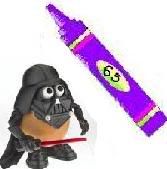
“I'm back. Anyway, just when I thought I was a total failure, I looked up and who should get off the bus? But Darth Tater! Mr. Potato Head’s Nephew.” The crayon went on to explain, “I met him during the interview a few weeks back.”

“As it turned out,” The 65th Crayon said gaining his crayonposure. “Darth had enough of the nice folks on the bus. He asked if he could hitch a ride with me back to Boston. It seemed like a chance to catch up on things, so I colorfully agreed.”

“When we got to Boston, he invited me to stay. He was hanging out at the home of a young lady he knows.”

The young Mr. Tater, also at Logan Airport, took the phone for comment.

“Six, that’s what I call him, was teaching me the advantages of crayon levitation over light sabers. We got so involved we had no idea that days had passed. It’s really my fault. I don’t even think that my lady friend even knew he was there.”

“Please don’t bring her into this.” the legendary spud’s nephew said. “She a great lady and she’s shown me such hospitality while I’ve been in town. We’ve done everything together. We’re even talking of crossing Jordan—though I’m not sure what that means. To protect her privacy I can’t tell you her name, but her initials are Jennifer Marie.”

“Darth, give-me-the-phone!” the 65th Crayon was heard to say.

“In any case, this case is closed. The flight is about to board. I’ll be home in about 3 hours if all goes as planned,” the reporter reported. “Please tell our readers I’m well and that I’m most apologetic. Also please tell all of the Jennifer Maries in and around the city of Boston and for that matter, any who have ever thought of Crossing Jordan, that Darth didn’t mean to give that name out. He’s just young and has a crush on her.”

The lady mentioned by the young Mr. D. V. Tater was unavailable for comment. It is said that she spent Saturday kayaking. We could not corroborate that. However, we were able to obtain this picture of the alleged shelter provider. Since the young woman depicted only allegedly gave shelter and then only possibly knew, in all fairness, we have altered the photo slightly for her protection.

As I complete the report, this editor still has questions—Just where do you go kayaking around Boston? Is Dark Tater sending a coded message from the Dark Side when he speaks of “crossing Jordan”?

We may never know.


—me strauss Letting me be
------------------------------------------------------------------------
For links to additional Scribbles Reports by the 65th Crayon see the sidebar listing under his picture and profile.
Scribbles Reports by The 65th Crayon appear Sundays in Letting me be ...
The 65th Crayon is a copyright of ME Strauss. All Rights Reserved.

Saturday, October 22, 2005

What Can't I Do?


Everyday I hear people argue for what they can’t do.

“I’m not creative. I can’t draw. I’m no good at writing. I’m awful at that.”

I do it too. “I swim like a rock,” I say.

I wonder how I’ll ever do something I’m so convinced I cannot do?

Admitting that I don’t know how . . .

Saying that that I’m not good at something . . .

They are not arguing for my limits.

Why would I argue that I can’t do anything?
—me strauss Letting me be

Checking for Credibility

Saturday Writer: Copyediting and Proofreading


A writer crafts a message.

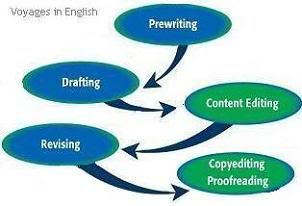
The writer’s job is to choose words with precision and arrange them carefully to convey meaning. The editor’s job is to ensure that the meaning the writer intends is indeed the one that reader receives. Sounds simple enough. It is. It’s elegant in its simplicity.

A content editor is the first to challenge the writing, looking for problems at the text level in the expression of ideas—logic, clarity, and cohesion. The copyeditor moves down to the sentence level to check for grammar, usage, mechanics, syntax and semantics. Proofreaders follow behind to check spelling and punctuation. They also check to ensure that no new errors have been introduced during the editing process.

This is a critical juncture. The focus has moved from “what” the writer is saying to “how” and “how well” the message is said.

Copyeditors and proofreaders drive some writers crazy. It’s true these specialists worry about things that the rest of us don’t remember. It’s true that on many points even they can’t agree with each other. It’s also true that a misplaced comma in a contract can cost millions of dollars. But more importantly, copyeditors and proofreaders catch errors that cause distractions—errors that get between the reader and the writer’s message.

Copyeditors and proofreaders are the superheroes that protect the writer’s credibility.

The message can be music. The prose can sing. Put a misspelled word in the middle, and the reader will stop for a second or so and lose sight of what the writer was saying.

If you can, get a friend to read after you. I have a friend who does that for me, as my eyes have a slight case of dyslexia. Early each morning she reads my blog and e-mails any corrections to me. She’s heaven sent in more ways than one. I value her. In no way does she make me crazy. I say thank you at least ten times a week.

Post Script
If you must go it alone, here’s a checklist and some tips for you.

Read paper if you can. Your eyes have more experience reading paper. They recognize mistakes in print more quickly than mistakes on screen. If you read on screen, adjust the text size up to a size you’re not used to reading. That will ensure that you see each word individually. In longer documents, check for only one or two checklist items at a time.

Copyediting and Proofreading Checklist

1. Are there any run-on or unnecessary rambling sentences?
2. Are there any unintended sentence fragments?
3. Is there a variety in sentence length and structure?
4. Are any sentences awkward or confusing?
5. Is every sentence logical and grammatically correct?
6. Is the information accurate and correct?
7. Are any words overused, redundant, repeated, or misused?
8. Are transition words used where they are needed?
9. Are all parts of the document included?
10. Are all sentences punctuated correctly?
11. Are all words spelled correctly?
12. Has the document been checked to ensure that no new errors were introduced?

If you let the work (and yourself) rest before you check it, you'll be more successful at finding errors instead of introducing new ones.

—me strauss Letting me be

---------------------------------------------

Definitions of Light, Medium, and Heavy Copyediting

Hints for Gaining Skill at Proofreading

Friday, October 21, 2005

What We Grew Up to Do

Editors were good at term papers in school.

Think about it.
Who else would want to be an editor?

What did the “cool kids” grow up to do?

They decide which links get recorded at Technorati and Truth Laid Bear.

What do you think the "cool kids" grow up to do?


—me strauss Letting me be

The Meme Story of Threes

So, Lori, the fineartist, tagged me with a meme. but I don’t do such things. So I had to find a creative way to respond without responding. . . .

Once upon a time, in a blog very near here, there lived a little big girl who had three names Maribeth, Liz, and ME. In the world of computers, she had three more. WhizLiz, LizWhiz, and Lizsun were those three. She favored the last of all of the names. It was most special to her heart and her ears. Lizsun. It’s like what you do with music, and she would Lizsun to music whenever and wherever she could. She’s always listening to Peter Gabriel, John Hiatt, and Johnny Clegg. They were in her headphones, on her computer, and in her little blue car—three musicians and three things she couldn’t do without.

Almost a princess, this little big girl, she was a saloonkeeper’s daughter, she learned storytelling at her father’s knee, while street-smarts was what her mother taught her. The rest of her heritage was that of a first-born, last-born, replacement child, the only girl who followed one who died. That she never made up for the missing one, doesn’t mean she never tried. She likes her towering height, her three-foot legs and eyes of shining blue. She isn’t crazy about her nose, her over-shy toes, or the prescription for her failing eyesight. Such a smart one, you would think that nothing scares this girl, but in fact she’s scared of people, of high, windy, open places, and of claustrophobic tiny, kinds of spaces.

Tonight after just writing about all three scary things, she decided to daydream about a perfect movie relationship.

She would be on vacation with Liam Neeson in Trieste, Italy, listening to “Desperado,” and then in Bologna with Val Kilmer singing along with John Hiatt’s “Have a Little Faith in Me. ” Lastly maybe she’d have a fling with Russell Crowe singing “Higher Love” in Tuscany. Every guy who watched her would promise love, honesty, and kindness. She would answer with lies—that she is predictable, dumb, and easy to get along with. Soon enough they would figure out the truth that also comes in threes: she can’t play chess; she can’t swim; and she can’t lie without people telling.

As the three men in her movie vie for attention, they would ask what appeals to her. She would say 6 foot 2, black hair, blue-eyes, and speaks no English. please. At which point, a nice Italian boy, fitting that description would draw a picture of him and her flying kites, listening to music, and driving with the top down. M-L-M would call him three names she liked, Lucas, Gabriel, and Michael. They would do three things she has always dreamed about: see the Aurora Borealis, fly in an airplane with a kingsized bed, and ride off into the sunset in a 1932 Model J Dual Cowl Duisenberg Touring Car.


“And that’s the end, the end, the end,” this little big girl said. “I don’t do memes. I won’t answer anymore. Besides I’ve mixed them up. You figure out what’s missing.”
—me strauss Letting me be

Thursday, October 20, 2005

Loud Voices

Sometime the ones who yell the loudest win.
Often what they're yelling isn't nice.
If they're yelling bad things about you, remember this.
Yelling the loudest doesn’t make them right.
Sadly yelling back is no defense.
Speaking quietly doesn't get heard.
They say time heals all wounds
and wounds all heels.
Sometimes I sure hope that is true.

—me strauss Letting me be

Photo Small Talk

I don’t carry photos in my wallet.

A large photograph of my son at five hangs in my office, but it’s unusual. It’s matted, cropped, and framed. What catches attention is the art of the lines and look on his face. He’s swinging on a playscape unaware of the camera. The smile is genuine straight through to his eyes. Designers passing by have stopped to discuss it as a work of art. It’s not unusual for a person to say that they didn’t realize that the child in the photo and I have a relationship, despite the fact that we look remarkably alike.

That works fine for me. I suspect my son likes it that way too. We’re not good at small talk.

Conversation about the weather stymies me. I have no place to put that information. My mouth can say the words, but my mind is screaming, “What’s the point?” I search for the right response and at best, it comes to me about three days later. I never know about the latest movie, or how the team is doing. I don’t listen to the radio or watch television. Add photos of my family into the lot and the confusion rises exponentially. I get self-conscious while I’m wondering why folks want to see pictures of people they will never meet.

When people show me pictures of their lives, I don’t know what to do. I want to run away, but I don’t want to be rude. I don’t know the right response. I don’t know how long to look. Nothing about the situation feels natural to me. Common sense on such occasions is an alien to me.

I’m trying to learn. Or maybe I’m just trying. Maybe I’m one of the most trying people folks ever will meet.

I watch people look at each other’s photos. They take in the whole picture. Then the conversation becomes some sort of photo small talk. The viewer and the photo owner discuss the people and the event depicted. They Q and A the details—who was there, how it came to be, how everyone is, was, and will be. They find out what Uncle Joe is doing now and whatever happened to Aunt Mary’s cat. This happens even though the people talking and those talked about have usually never met.

It scares me to do any of at that—even looking at the whole picture. When I do I see a picture of someone I don’t know. It’s the same as looking at a wallet photo. An eerie feeling comes over me as if I’m meant to make up questions about the people in the picture frames at the local pharmacy.

So I’ve developed coping mechanisms. I focus on the details, and that seems to work. No one seems to know I’m “passing” as a person who can small talk about photos.

If I don’t know the subject or I’ve just met the photo’s owner, I get involved in the potential of the photo—I talk about how it might be cropped, what steals my attention, or what sort of story I might tell about the photo. If I know the subject or the owner, I go to the eyes of the person in the photo. The eyes always talk to me. No matter the occasion or the skill of the photographer, it’s rare the photo that masks the meaning that is shared by human eyes.

I’ve seen intelligence, fear, shyness, sadness, joy, love, gentleness, and sheer exhaustion. More often than you might expect, I’ve seen the way a person feels about being the subject of a photo. Once in a while, the eyes show emptiness, a blank tight-fisted stare. Now that’s a person that I’m sure I wouldn’t want to know.

I’m not suggesting that I say exactly what I see.

By looking at the eyes, I’ve found an honest way to look at other people’s photos. The proud owners are naturally pleased that I take time and show an interest. What I see can sometimes present a challenge to offering a kind and positive comment. Then again with that information, I don’t feel intimidated when I look into the owner’s waiting eyes again.

They say the eyes are the window to the soul. You can see a lot in someone’s eyes. They also say that certain tribes once feared that cameras stole your soul. There may be something to that, especially if the eyes are the windows to the soul. I don’t claim to know.

I know the eyes make it easier for me to look at other people’s photos.
—me strauss Letting me be

Wednesday, October 19, 2005

Joyful “Sort of” Story

Melly tagged me to find a post about joy. (More on that follows.)
I can’t imagine anyone would be more surprised than I was to find so much joy on my blog. I chose about half of what I found to tell this joyful “sort of” story.

My dad left home at age 12. It was 1919. He knew the hardest sides of the world. When he said, “trust nobody,” he knew what he was talking about. It was one of a litany of lessons he shared daily. I saw the signs of those lessons written on his hands, his back, and his face, but not in his eyes, never his eyes. His eyes only spoke hope and joy.

I’m definitely my daddy’s girl. . . .

Usually I’m a Weimaraner puppy, chasing over nothing just for the joy of living—sometimes to the point of wearing myself out. I can break your vase and fetch a stick, but no one trained me just to sit and wait for my whole future to take its time to come to me.

Finally I got to an age where I gained a little sense. I quit taking the blame for everything on the planet. My skin seemed to fit just fine most of the time. I realized that I was a best judge of my behavior, and most importantly, that I was cheating myself if I didn't enjoy—note to self: see the big word joy inside that verb—every second of contentment this planet has to offer. I quit flinching at my own happiness. I went back to thinking that the world is beautiful and that people are the best species God ever created.

Some nights, like tonight, I reintroduce my brain to my heart. All of me just kind of hangs out together and reacquaints itself with the quieter, introverted side of me. Grand ideas—peace, joy, and beauty—fill my thoughts. Now it’s no big deal to relax, waiting for morning to take in a sunrise or daydreaming under the night sky. It’s hard not to feel alive when you’re looking at the night sky. Imagine we’re made of stardust and you can’t help but feel good about the world.

Duncan says that the world needs incurable idealists like us. He says we balance out the hardcore cynics. It has to do with joy, and hope, and possibility. I like the thought of providing balance. So I hold tight to my world view, even though I know that people can do despicable things. I don’t want despicable people choosing my world for me. My world needs people who believe in it as much as I need people who believe in me.

But there are days, and this is one, when friendship sees to shine, when reason sets itself aside to make room for feeling good. Suddenly I understand that I have things that others see only in their dreams. I have friends who are the best of those around. It’s hard not to enjoy a world that gives and gives and gives so much. It’s even harder not to love the friends who make it turn. Every one of you.

I love the joy of gratitude.

Thank you, Melly, for asking me to do this. Putting this together was a joyful thing.
—me strauss Letting me be

The Search for JOY

Melly at All Kinds of Writing tagged me in what I think is a really fine example of what a writing challenge might be. The event is called The Search for Joy. How could any self-respecting optimist turn that kind of challenge down?
As I describe the challenge, I hope that Garnet, Scot, Tanda, Lance, and Mark pay attention, because I am officially tagging you to do the same.

Of course, if you wish to ignore the tag, you should feel free . . .

THE SEARCH FOR JOY
Search your blog for the word "“joy" used in the context of "“happiness."” If you cannot find the word in your weblog, you may use any of the select list of synonyms below.

joy --— amusement, bliss, cheer, comfort, delectation, delight, ecstasy, elation, exaltation, exultation, exulting, felicity, gaiety, gladness, glee, good humor, gratification, happiness, hilarity, humor, jubilance, liveliness, merriment, mirth, pleasure, rapture, regalement, rejoicing, revelry, satisfaction, wonder

If your weblog does not include a built-in search engine, use
Google to search for the word you wish to find. If you’ve found the word and it was not used facetiously or sarcastically, good for you. All you need to do is link to your earlier entry, and write a few words about that joyous moment.
If, however, you have no joy (whole words only) in your weblog, you must dig deep in your soul and find something wonderful in your life right now. One little thing that fills you with warmth, that bubbles you over with quiet happiness, or tickles you with its good-hearted hilarity, or makes you glad you just took a breath, and are getting ready to take another. It doesn't have to be anything big. A smile someone gave you; your cat on your shoulder; the way the light angles through your window and casts rainbows on your floor. All it has to be is something genuine, something real, something that matters to you.

We all need joy in our lives, and need to take the time -- from time to time --— to recognize it. And sometimes, we need to pass it on. Even if we're a big pain when we do.
When you'’ve written of your own joy, pass the quest on to five other bloggers.
I'd say more about joy and this writing challenge, but I'm off to take up this gauntlet myself. . . .
UPDATE: I KNOW A HUNGRY WRITER. HE DOES NOT HAVE A LOT OF OLD POSTS, BUT I BET HE COULD WRITE A GREAT NEW ONE ON JOY.
I CHALLENGE HIM TO—AS A CHICAGO GIRL MIGHT CHALLENGE A NEW CHICAGO BOY.
—me strauss Letting me be

Tuesday, October 18, 2005

The Mystery of Dark and Light

If the world is a mystery of dark and light . . .

What does that say about colors?


—me strauss Letting me be

If You Would Smile

I had a meeting. I had to go somewhere I’d never been before. I find that stressful. I didn’t know how to get there. The cab driver didn’t either. Apparently he was even less comfortable with the idea than I was.

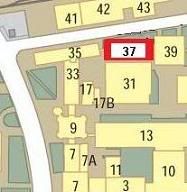
“Building 37 MIT, please,” I said.

“Do you have an address? I won’t go without an address,” he said without moving the car.

“I’m sure I do,” I said. “Give me a minute. In the meantime, it wouldn’t bother me at all if you chose to smile.”

He didn’t. In fact, I got the distinct feeling that he didn’t believe that I had the address. He didn’t move the taxi forward either—despite the taxi pulled up behind us waiting.

Now I felt even more stressed. Why was I feeling responsible for this guy’s misbehavior? My nature I guess. I reached in my bag and pulled out the e-mail that carried the address of Building 37.

“Okay, here it is—77 Mass Ave.” He didn’t believe me. I had to show him.

Was I giving off some sort of “push me around” vibe? Had my younger, older brother been here before me, whistling and telling stories? What was going on? Strangers usually reacted positively to me.

I showed him the address in print.

“Okay I’ll take you.” he said.

I wasn’t sure what my response was supposed to be. Okay, he’ll take me? My understanding of capitalism was that I pay. He takes me. Was I confused? Was he?

He drove to the address. Part way there he asked if I wanted a receipt. Was he trying to make up with me? I cheerfully said, “Yes, thank you. That would be good.” He handed one to me.

It was an $8.00 ride. Upon reaching our destination, I got to see the nicer side of the man behind the wheel. A cynic might say he had started to think about the tip. I gave him the fare and a tip. I lived for tips once. It was for me and for him.

He said, “Have a good day.”

My first thought was, “Too late.” Then I looked at the beautiful blue sky and thought again. I said instead, “You know I plan on it! You too. Have a lovely day. By the way, I just know you’re even better looking when you smile.”

As he said goodbye, he did.
—me strauss Letting me be

Monday, October 17, 2005

Family Friends

I used to wonder. . .
If they weren’t my brothers,
would we ever have been friends?

Would they choose me?
Would I choose them?
What are your thoughts on that?
—me strauss Letting me be

NFTV: Organic Chemistry ME

It was last July. My son and I were in a neighborhood restaurant. The place has to be the tiniest Mexican restaurant in the city. It’s one block from where we live, and the food is authentic, homemade, and delicious—except for the sopapillas, which are flat and hardly worth the waste of good honey.

We had arrived early in the evening and were seated at a table for two in the back corner of the store-front establishment. The room was the size of a master bedroom. Ours was one of twenty tables arranged in four columns and five rows. with a slightly wider center aisle. Having lived in Texas, we knew our way around a Mexican restaurant menu. We place our orders almost before our behinds hit the seats.

The little two top, covered with white butcher paper, barely fit me, my son, and his Organic Chemistry book. Still he pulled it out and started writing. This behavior was nothing new.

So opens another episode of Nerd Family TV.

“What are you doing?”

“I’m studying Organic Chemistry.”

“We’re at dinner.”

“I know, but class starts in three months. I want to work all of the problems before classes begin. I won’t have time then.”

“I see. What chapter are you on?”

“Chapter 7.”

“I think you have time for a small dinner break.” The food arrived as if on cue.

“What? You want to take a look at my book. Don’t you?”

“Well, yeah.”

He passed over the textbook, and I started paging through it. My son kept working the practice problem that he was on. We both begin eating.

“I’m not sure that I would trust a book on Organic Chemistry with an author who called himself “Buzz.” My son just shakes his head. He continues working and eating.

“Well, this helpful hint is super.” I say with the lilt of sarcasm.

“What?”

“It says if you want to know what’s in the chart, read the chart.”

My son gives me a look that says “Okay, Mom, if that’s all you can find . . . ”

I mention two others that have a genuine DUH factor. He asks me to explain what I mean. Little did I know he was letting me take enough rope to tie myself into the conversation.

Then he put his plan into action.

“So what do you think of that molecule there? Isn’t it cool?” he said. “Huh? Huh?”

“It’s pretty. Though I might have chosen a slightly bluer shade of green.” He ignored my color choice and instead explained exactly what molecule it was that I was critiquing. Roped in. There I was attempting to make something of bad sopapillas, and he was teaching me Organic Chemistry.

He repeated the procedure for two or three molecules, until it was fully proved that I wasn’t paying attention. I was just not learning. I needed to drop this class. His approach to Organic Chemistry as Dinnertime Fun was not working.

He’s a smart guy. He changed the plan.
Out came his pen and he began drawing on the paper tablecloth. His drawing, which looked vaguely familiar, was entirely in chemical notation. When he’d finished his artwork, he looked up at me with a rare smile.

’What do you think?”

“Of what?”

“Of your picture? I just drew you in Chemical Notation.”

“What?”

He explained how he used carbon molecules to make my head, torso, arms, legs, feet, hands, fingers, and toes.

“Wait a minute, I only have three fingers on each hand, same thing with the toes.”

“Carbon only bonds in threes.”

“I want the normal five. What would the neighbors think?”

“Well I could give you two helium. That's the next closest, but there would be a problem.”

“What’s that?”

“The two helium fingers would be five miles long.”

“Those are my choices?”

“Yes. That’s how it works.”

“I give. There’d be no getting gloves to fit them.”

“Exactly.”

I hadn’t paid attention to whether anyone had been looking or listening. But there was no missing that the whole restaurant watched us walk out the door. Apparently that episode of NFTV had it’s highest viewership. Maybe we should have waited to have that conversation during sweeps week.

Why am I still wondering whether I should go for the helium fingers?
—me strauss Letting me be

Sunday, October 16, 2005

Scribbles: Trees Turn Colors—CRAYON MISSING!

This Just In from The 65th Crayon:

“At first I thought it was a trick of the light. They’ve been getting a lot of rain around here,” said the 65th Crayon upon reaching his favorite cookie tin in Bedford, Massachusetts on Friday. “I came out early to visit my friend, Chip, at the Tollhouse Inn. On the ride from the airport, I kept getting glimpses of something that didn’t seem right. Frankly the greens were looking strange to me,” he said. “Being a crayon, I’m sensitive to such things.”

“It became apparent that even now and then one of the trees wasn’t green.” The depth of our super sleuth reporter’s concern colored the statements coming over the cell phone he was using. “The trees were red, orange, and yellow—alien colors,” he remarked. “I talked to Chip about it as soon as I arrived. Chip seemed oblivious. He doesn’t get outside often—too much dough invested in the cookie biz. I had to check it out myself.”

The 65th Crayon had flown out to the Commonwealth at the invitation of the Massachusetts Institute of Technology. The Head High Out-of-the-Box Crayon was to sit alongside Clocky, the winner of last week’s NO BELL, BOOK or CANDLE Award, as Co-Parade Marshall in a toilet-paper, ticker-tape parade through the bedroom suite where Clocky was first tested. Clocky won the prestigious NBBC Award given by the Royal Order of the Benevolent Society of Pure Color Wax Crayons for being the first alarm clock that runs and hides when you try to turn it off.

“As soon as I saw the trees, I called Clocky to demur. I had to leave a message. Every time he heard the phone ring, he ran and hid.” our crayon comrade reported. “As much as I wanted to be part of the festivities—I’ve never been a Co-Grand Marshall before—I need to check out this alien tree invasion. It could be nothing but it could be serious,” the Superhero of Crayons stated. “We don’t need unearthly things going on in Massachusetts.”

The 65th Crayon reported back in after 24 hours spent in stakes and deep cover, posing as a pencil.

“I’m relieved. The thought of alien tree people was colorific.” the 65th Crayon sighed when he called in on Saturday. “It seems the red, yellow, and vibrant orange leaves are a phenomena of Earthly nature. Leave it to trees to do such a thing,” the reporter expounded. “It seems that they put their chlorophyll away for the winter and start showing off for a couple of weeks.”

“No self-respecting crayon would ever give up control of his color,” said Forest Green shaking his head.

“If I did such a thing, I’d be deadwood brown,” said Cerulean. “My mom, Aquamarine, would send me to the box for sure.”

“Crayons and trees are both tall and hug-able,” said our sage reporter. “But it appears there is much we don’t know about each other.”

“The parade turned out fine without me or Clocky. I understand he’s still somewhere in hiding,” the reporter informed us. “Wait. An alien bus just drove by. It appears to have eaten a passel of people!”

At that point the cell phone connection was lost.

Massachuetts Authorities say that Massachusetts is famous for bad cell phone connections and for bus loads of people out to see the fall color in any sort of weather.

Management of Letting me be . . . having the utmost faith in our invincible investigator has decided to wait before putting out a purple crayon alert. It is our wish to avoid any action that might embarrass or thwart our robust reporter.

Anyone with information pertaining to the whereabouts of the 65th Crayon is asked to comment within any article on this blog.

—me strauss Letting me be
--------------------------------------------------------------------------------------------------
America’s 50 Favorite Colors

“The Colors of Childhood,” Smithsonian Magazine, (November 1999)

Scribbles: Crayon NO BELL AWARDS

For links to additional Scribbles Reports by the 65th Crayon,
see the sidebar listing under his picture and profile.
Scribbles Reports by The 65th Crayon appear Sundays in Letting me be ...
The 65th Crayon is a copyright of ME Strauss. All Rights Reserved.